AI & Tools
Freelancing vs a Full-Time Job
Freelancing vs a full-time job compared honestly: income stability, benefits, self-employment taxes, freedom and risk, plus how to test freelancing first.
· 7 min read
Be your own boss, carefully
Being your own boss means choosing your work and your hours, and also replacing everything your employer quietly handled: a steady paycheck, health insurance, tax withholding and paid time off. This page compares the three main ways people work for themselves, shows the safety net to build first, and explains how to test your plan on evenings and weekends before you hand in your notice. Most people need many months of side income before the switch makes sense.
Secure checkout by Hotmart · 7-day money-back guarantee
To work for yourself, pick one way of earning without an employer (freelancing your skills, running a small online business or self-employed gig work), start it on the side while you still have a job, and only switch once it brings in steady income and you've built a safety net. That net means several months of savings, a health insurance plan (in the US, the HealthCare.gov Marketplace is open to self-employed people) and money set aside for self-employment tax, which is 15.3% on net earnings in the US. Plenty of people try it and go back to a job, so treat the first year as a test, not a leap.
Part of our honest guide to making money online.
Sound familiar?
You want out, but the paycheck is the only thing holding you
Rent, bills and maybe a family depend on a salary that arrives every two weeks. Working for yourself sounds like freedom until you picture a month with no income.
Health insurance and taxes feel like a cliff
Your employer handles coverage and withholding today. You've heard about quarterly taxes and expensive premiums, but you don't know the real numbers or where to start.
You don't know which kind of 'self-employed' fits you
Freelancing, an online shop, driving for an app, consulting: they are very different lives, with different income patterns, and most advice treats them as one thing.
You're afraid of quitting and failing in public
Telling your boss, your family and your friends that you're going solo, then having to look for a job again six months later, is the fear that keeps you stuck.
The turning point
Working for yourself is less about courage and more about evidence. The safest path builds proof of income and a safety net before the paycheck stops.
Choose the kind of self-employment that fits you
Freelancing sells your skill and time to clients, a small online business sells products or services to many buyers, and gig work trades flexibility for lower, less predictable pay. Matching the path to your skills and risk tolerance comes first.
Build income before you build courage
Running the work on evenings and weekends shows whether clients or buyers pay, how much you keep after costs and how many hours it really takes. Those numbers, not motivation, tell you when switching is reasonable.
Replace the employer benefits on purpose
Savings for slow months, a health plan, a tax set-aside and a retirement plan are things a job gave you by default. Planning each one before you quit removes most of the risk people fear.
How this is different: A lot of 'be your own boss' content celebrates quitting first and figuring it out later. This approach does the opposite: keep the job, prove the income, build the safety net, and leave only when the numbers say you can.
How it works
Choose your path
Compare freelancing, a small online business and gig work against your skills, savings and how predictable your income needs to be. Our comparison of freelancing vs a full-time job lays out the trade-offs.
Check your contract, then start on the side
Read your employment contract for moonlighting, conflict-of-interest or non-compete clauses, keep side work off your employer's time and equipment, and give it a fixed number of hours each week.
Track real numbers for several months
Record income, costs, hours and where clients or buyers come from. Look for income that repeats month after month, not one good week.
Build the safety net
Save several months of essential expenses (see how to build an emergency fund), price out health coverage, and open a separate account for your tax set-aside.
Set a switch rule and a way back
Decide in advance what monthly income and savings level would let you go full time, and what would send you back to a job. Our guide to turning a side hustle into full-time income covers the checkpoints.
Secure checkout by Hotmart · 7-day money-back guarantee
The skills involved
Selling your work without a boss handing it to you
Finding clients or buyers, pitching, following up and asking for referrals. When you work for yourself, getting work is part of the job every single week.
Pricing that covers what an employer used to pay
Rates that include taxes, insurance, unpaid admin time, equipment and time off, which is why a self-employed hourly rate has to be well above an equivalent salary's hourly rate. See how to price freelance work.
Self-employment tax and estimated payments
In the US, self-employment tax is 15.3% (12.4% Social Security plus 2.9% Medicare) on net earnings, it applies once net earnings reach $400, and quarterly estimated payments are generally required if you expect to owe $1,000 or more. Half of it is deductible when figuring income tax.
Health coverage without an employer
In the US, self-employed people with no employees can buy a plan through the HealthCare.gov Marketplace, where savings depend on your estimated net income. The yearly sign-up window on HealthCare.gov runs November 1 to January 15, and losing job-based coverage usually opens a special sign-up window outside it.
Cash-flow planning for uneven income
Paying yourself a steady amount from a business account, keeping a buffer for slow months and chasing late invoices, so a quiet month doesn't become a crisis.
The rules outside the US
UK sole traders must register for Self Assessment once they earn more than £1,000 in a tax year. In Canada, self-employed people report business income on Form T2125 and pay both the employee and employer share of CPP contributions. In Australia, you apply for a free ABN when you start carrying on an enterprise.
Managing yourself
Setting hours, protecting focus, avoiding burnout and isolation, and making decisions without a manager. For many people this is harder than the work itself.
Secure checkout by Hotmart · 7-day money-back guarantee
Realistic expectations
| Path | How you earn | Upfront cost | Income pattern | Biggest risk |
|---|---|---|---|---|
| Freelancing | Clients pay you for a skill (writing, design, bookkeeping, development, admin) | Low; mostly a computer and samples | Uneven at first; can become steadier with repeat clients | Losing one big client; underpricing |
| Small online business | Buyers pay for your products or services (digital products, reselling, an online store) | Low to moderate, depending on inventory, tools and ads | Slow to build; can grow beyond your own hours | Months of work before meaningful revenue |
| Self-employed gig work | Apps pay per delivery, ride or task | Low if you already have a vehicle and phone | Flexible and fast to start, but demand and pay vary | Costs such as fuel and vehicle wear reduce real hourly pay |
| Hybrid (part-time job plus your own work) | A smaller paycheck plus self-employment income | Low | More stable while the business grows | Less time to build; still need to manage taxes on both |
Illustrative comparison based on how each path works, not a survey; income varies widely by skill, location, hours and effort, and many people combine paths. US tax figures are from IRS guidance as of 2026; check your own country's tax authority. Learn more in our explainer on what gig work is.
Is it right for you?
This is for you if…
This is NOT for you if…
401
free guides published
3,028
official sources cited
0
income promises
Oct 3, 2026
last updated
Every guide is checked against official sources. See our editorial policy.
From readers of the ebook
“I found some interesting ideas for earning extra income in my spare time.”
“The examples helped me think about how I could use my skills for freelance work.”
“I liked exploring extra-income options that could fit around my studies.”
“The information gave me a starting point for planning a small side project.”
“I felt more organized after outlining what I could offer and how much time I had available.”
Shared by buyers who agreed to publication. These are individual experiences, not typical results, and none of them describes earnings. See our earnings disclaimer.
Who's behind this
Getback publishes free, practical guides on making money online and managing it well. We show real costs, realistic timelines and the trade-offs most “gurus” skip — and we never promise income. Read how we research and update every guide in our editorial policy.
Go deeper
The ebook
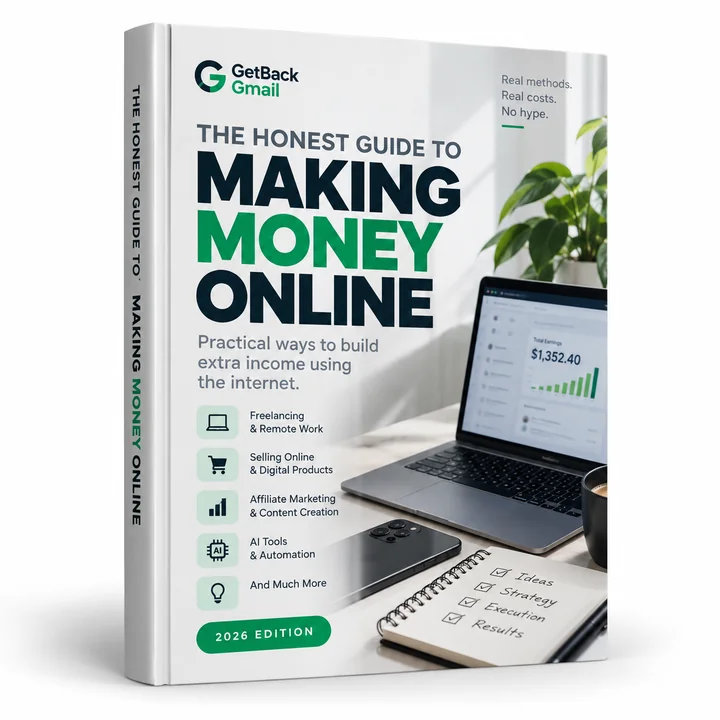
A practical, beginner-friendly ebook about realistic ways to earn money online. Instead of promising quick or guaranteed income, it explains how each method works, what it may cost to start, the skills involved, common mistakes to avoid and practical first steps.
How the ebook fits: The ebook covers the earning side of working for yourself: freelancing, side hustles, selling online and other realistic paths, with what each may cost, the skills involved and the mistakes to avoid, so you can pick one to test while you still have a paycheck. It does not cover health insurance, retirement planning or detailed tax rules; for those, this page points you to the official IRS and HealthCare.gov pages.
Secure checkout by Hotmart · 7-day money-back guarantee
One-time payment · instant digital access
The Honest Guide to Making Money Online
Today's price is shown at checkout in your local currency. Payment and delivery by Hotmart.
Secure checkout by Hotmart · 7-day money-back guarantee
Go through the lessons. If you decide it isn't for you, request a refund within 7 days through Hotmart and you get your money back, no questions asked.
Free PDF
Every step to get started, a 7-day plan, the numbers to track and the scams to skip — on two printable pages.
Questions
Start with something that sells a skill you already have, such as freelancing, or that uses things you already own, while you keep your job. It costs little cash but takes time. Our list of ways to make money without a job shows low-cost options.
There is no single number, but many people aim for several months of essential expenses, plus a separate set-aside for taxes and health coverage. The steadier your side income already is, the smaller the gap your savings need to cover.
Regular income tax plus self-employment tax of 15.3% on net earnings, which covers Social Security and Medicare. It applies once net self-employment earnings reach $400, and you generally pay quarterly estimated taxes if you expect to owe $1,000 or more for the year.
Common options are a plan through the HealthCare.gov Marketplace (or your state's marketplace), a spouse's employer plan, or temporary COBRA coverage from your old job, which applies to employers with 20 or more employees and usually means paying the full premium yourself. When you apply on the Marketplace, you estimate your net self-employment income to see what savings you qualify for.
Freelancing usually pays sooner because clients pay for your time, while an online business takes longer but can grow beyond your own hours. Many people freelance first for steady income and build a product on the side. Compare the models in our page on online business ideas.
It's a beginner-friendly ebook that compares realistic ways to earn money online — freelancing, remote work, side hustles, affiliate marketing, digital products, AI tools, selling online and other legitimate paths. For each one it explains how it works, what it may cost to start, the skills involved, common mistakes and practical first steps. It's an overview to help you choose, not a specialist manual on a single method.
Beginners who want an honest map before they spend time or money — people with a job, students, parents at home — and who are willing to put in consistent effort. It is not for anyone looking for a shortcut.
It varies a lot and depends on your skills, effort, market and execution. Many beginners need weeks to months of consistent work before earning anything meaningful, and some never do. Anyone promising fixed results or timelines is not being honest with you.
The price is shown at checkout in your own currency, as a one-time payment. Several of the methods in the ebook can be started with little or no money beyond a phone or computer; paid tools are explained with their real costs before you decide.
Payment and delivery are handled by Hotmart. After checkout you receive an email with access to the ebook, available right away.
Yes. You have a 7-day money-back guarantee under Hotmart's refund policy. If it isn't for you, request a refund within 7 days of purchase and you get your money back.
Yes. It's a digital ebook you can read on a phone, tablet or computer.
The ebook is sold through Hotmart, a large digital-products platform, and comes with a money-back guarantee. It doesn't promise income — it explains methods, costs and risks so you can decide for yourself.
Being your own boss means choosing your work and your hours, and also replacing everything your employer quietly handled: a steady paycheck, health insurance, tax withholding and paid time off. This page compares the three main ways people work for themselves, shows the safety net to build first, and explains how to test your plan on evenings and weekends before you hand in your notice. Most people need many months of side income before the switch makes sense.
Secure checkout by Hotmart · 7-day money-back guarantee
Freelancing vs a full-time job compared honestly: income stability, benefits, self-employment taxes, freedom and risk, plus how to test freelancing first.
· 7 min read
How to turn a side hustle into a full-time job safely: the income you really need, readiness signs, a savings runway, insurance, taxes and a gradual exit.
· 7 min read
How to build an emergency fund from zero: how much you need, a starter goal, where to keep it, how to fund it on a tight budget and when to use it.
· 7 min read
Also consider: Freelancing With AI · Side Hustles · or browse every way to make money online.
Earnings disclaimer: Results vary from person to person and depend on effort, market and execution. This is educational material and does not guarantee earnings. See our full earnings disclaimer.