Money & Investing
How Does the Stock Market Work? A Plain-English Guide
How the stock market works in plain English: what a share is, who buys and sells, why prices move, and what it means for a beginner investor.
· 8 min read
Investing for beginners
A free, plain-English investing guide for complete beginners. Below you'll learn how markets work, how to get your finances ready, which tax-advantaged accounts exist where you live, and how to judge fees and risk before you put in a single dollar. It's slow, deliberate learning: most people spend a few weeks on the groundwork before their first small investment, and investing always involves the risk of losing money.
Secure checkout by Hotmart · 7-day money-back guarantee
To start investing, first cover the basics: a small emergency fund and a plan for any high-interest debt. Then choose an account type that fits your goal and country (for example a 401(k) or IRA in the US, an ISA or SIPP in the UK, a TFSA or RRSP in Canada, or super in Australia), open it with a regulated provider, and invest small, regular amounts in diversified, low-cost funds you understand. Investing involves risk, including loss of the money you put in, and past performance does not guarantee future results.
Part of our honest guide to making money online.
Sound familiar?
You're afraid of losing money you worked hard for
Prices move every day, headlines swing between boom and crash, and nobody explains what a normal drop looks like or how to size your first investment so a loss doesn't hurt your rent money.
The jargon makes you feel behind
Expense ratios, ETFs, Roth, ISA, TFSA, rebalancing, dividends. Every guide assumes you already know half the words, so you close the tab and leave your savings in a current account.
Everyone online is selling a hot pick
Social feeds are full of people promising fast gains from a single stock, a coin or a trading course. It's hard to tell education from a sales pitch, or a real firm from a scam.
You don't know if you're ready or where to begin
Should you pay off debt first? Build savings first? Which account, which provider, how much? Without an order of operations, it feels safer to do nothing.
The turning point
Beginners rarely go wrong by picking the 'wrong' fund. They go wrong by investing money they need soon, paying fees they didn't notice, or panicking in a downturn. This guide focuses on the decisions that matter most.
Foundation before investments
An emergency fund and a plan for high-interest debt mean a surprise bill doesn't force you to sell at a bad time. That's what lets you stay invested through ups and downs.
The account matters as much as the investment
Tax-advantaged accounts such as a 401(k), IRA, ISA, TFSA, RRSP or super can change what you keep over decades. Understanding the ones available in your country is a core skill.
Costs and behaviour are what you control
You can't control markets, but you can control fees, diversification, how regularly you invest and how you react to a drop. Those habits compound, just like returns.
How this is different: Most 'investing for beginners' content either sells a stock tip or buries you in theory. This is neither: it's a plain-English, step-by-step education in how investing works, what to check and what to avoid, so you can make your own informed decisions. It is not personal financial advice, and it never tells you what to buy.
How it works
Get your money ready
Build a starter emergency fund and deal with high-interest debt first. Our guide on how to save money covers the groundwork.
Learn the core building blocks
Understand stocks, bonds and funds, how the market works, and why diversification and time horizon matter more than predictions.
Pick the right account for your country and goal
Compare workplace plans and individual accounts such as a 401(k), IRA, ISA, SIPP, TFSA, RRSP or super, and check the provider is regulated and protected.
Start small and automate
Begin with an amount you could leave invested for years, set up regular contributions, keep costs low and review once or twice a year instead of daily.
Secure checkout by Hotmart · 7-day money-back guarantee
The skills involved
Know when you're ready to invest
Work through a simple checklist covering emergency savings, high-interest debt and short-term goals, so the money you invest is money you can leave alone.
Understand how the stock market actually works
See what a share, a bond and a fund really are, who's on the other side of a trade, and why prices rise and fall. Start with our explainer on how the stock market works.
Use the tax-advantaged accounts in your country
Learn how 401(k)s and IRAs, ISAs and SIPPs, TFSAs and RRSPs, and Australian super work, what the contribution limits mean and where to confirm the current figures.
Read fees like a pro
Find expense ratios, platform fees, trading costs and fund charges in the documents, and see how a small percentage difference can add up over decades.
Build a simple, diversified portfolio
Understand index funds, target-date and all-in-one funds, and how to match your mix of stocks, bonds and cash to your time horizon and risk tolerance.
Choose and check a provider safely
Compare brokers and platforms on costs, account types and features, and verify registration and protection with tools such as FINRA BrokerCheck, the FCA register or CIRO's AdvisorReport.
Stay calm when markets fall
Learn what normal volatility looks like, why selling in a panic locks in losses, and how automatic contributions and rebalancing keep you on plan.
Spot scams and hype before they cost you
Recognise the warning signs regulators flag, such as promised returns, pressure to act fast and unregistered firms, and know how to report them.
Secure checkout by Hotmart · 7-day money-back guarantee
Realistic expectations
| Stage | Typical time | What you do | What happens |
|---|---|---|---|
| Get ready | 2-8 weeks | Build a starter emergency fund, list debts and set one investing goal | You know how much you can invest without touching bill money |
| Learn the basics | 1-3 weeks | Study stocks, bonds, funds, fees and the accounts available in your country | The jargon stops being a barrier and you can read a fund fact sheet |
| Open an account | A few days | Compare regulated providers, check protection and open the account type you chose | Identity checks may take a day or two; your account is ready to fund |
| First investment | One afternoon | Invest a small amount in a diversified, low-cost option and set up a regular contribution | Your balance will move up and down, sometimes sharply |
| Stay the course | Years | Keep contributing, review once or twice a year, rebalance when needed | Results depend on markets, costs and time; losses are possible and nothing is promised |
Illustrative ranges for learning and setup only. They are not a prediction of investment returns. Investing involves risk, including loss of principal, and past performance does not guarantee future results.
Is it right for you?
This is for you if…
This is NOT for you if…
Who's behind this
Getback publishes free, practical guides on making money online and managing it well. We show real costs, realistic timelines and the trade-offs most “gurus” skip — and we never promise income. Read how we research and update every guide in our editorial policy.
Go deeper
The ebook
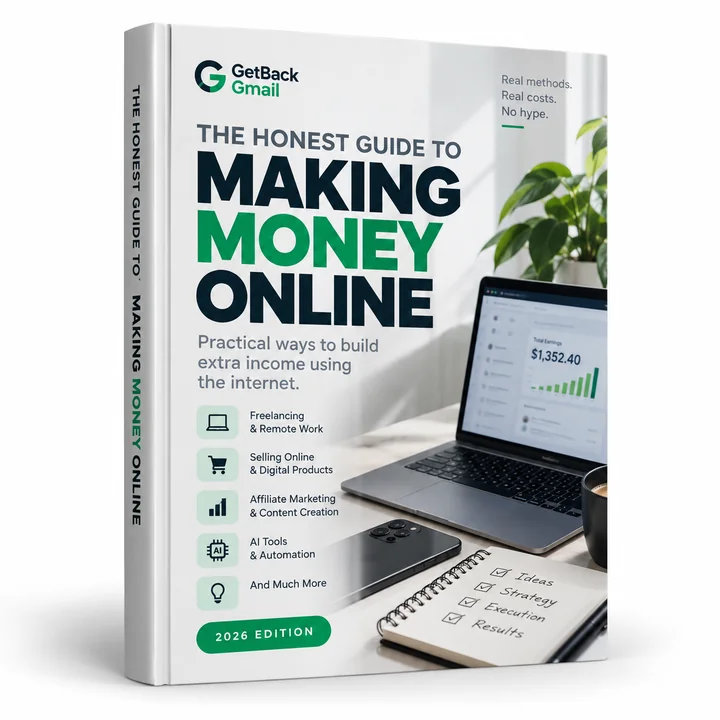
A practical, beginner-friendly ebook about realistic ways to earn money online. Instead of promising quick or guaranteed income, it explains how each method works, what it may cost to start, the skills involved, common mistakes to avoid and practical first steps.
How it relates to investing for beginners: It doesn't teach saving or investing. It covers realistic ways to earn extra income online, which is the money you'd save or invest.
Secure checkout by Hotmart · 7-day money-back guarantee
One-time payment · instant digital access
The Honest Guide to Making Money Online
Today's price is shown at checkout in your local currency. Payment and delivery by Hotmart.
Secure checkout by Hotmart · 7-day money-back guarantee
Go through the lessons. If you decide it isn't for you, request a refund within 7 days through Hotmart and you get your money back, no questions asked.
Questions
No — educational. This is general investing education for beginners. It doesn't consider your personal circumstances and never recommends specific investments. For personal advice, speak to a licensed or regulated financial adviser in your country.
Often less than people think. Many providers have low or no account minimums and some offer fractional shares. The more important question is whether you have an emergency fund first. See how much you need to start investing.
Yes. Investments can fall in value and you may get back less than you put in. Diversifying, keeping costs low and investing for the long term can reduce some risks, but no approach removes them, and past performance does not guarantee future results.
The main types are the 401(k), IRA and Roth IRA in the US, the ISA and SIPP in the UK, the TFSA and RRSP in Canada, and super in Australia. Rules and contribution limits change, so confirm the current figures on official government sites before you open one.
Regulators such as the SEC and the FCA suggest dealing with high-interest debt and keeping some emergency savings first. Our guide on emergency fund vs investing walks through the order.
It's a beginner-friendly ebook that compares realistic ways to earn money online — freelancing, remote work, side hustles, affiliate marketing, digital products, AI tools, selling online and other legitimate paths. For each one it explains how it works, what it may cost to start, the skills involved, common mistakes and practical first steps. It's an overview to help you choose, not a specialist manual on a single method.
Beginners who want an honest map before they spend time or money — people with a job, students, parents at home — and who are willing to put in consistent effort. It is not for anyone looking for a shortcut.
It varies a lot and depends on your skills, effort, market and execution. Many beginners need weeks to months of consistent work before earning anything meaningful, and some never do. Anyone promising fixed results or timelines is not being honest with you.
The price is shown at checkout in your own currency, as a one-time payment. Several of the methods in the ebook can be started with little or no money beyond a phone or computer; paid tools are explained with their real costs before you decide.
Payment and delivery are handled by Hotmart. After checkout you receive an email with access to the ebook, available right away.
Yes. You have a 7-day money-back guarantee under Hotmart's refund policy. If it isn't for you, request a refund within 7 days of purchase and you get your money back.
Yes. It's a digital ebook you can read on a phone, tablet or computer.
The ebook is sold through Hotmart, a large digital-products platform, and comes with a money-back guarantee. It doesn't promise income — it explains methods, costs and risks so you can decide for yourself.
A free, plain-English investing guide for complete beginners. Below you'll learn how markets work, how to get your finances ready, which tax-advantaged accounts exist where you live, and how to judge fees and risk before you put in a single dollar. It's slow, deliberate learning: most people spend a few weeks on the groundwork before their first small investment, and investing always involves the risk of losing money.
Secure checkout by Hotmart · 7-day money-back guarantee
How the stock market works in plain English: what a share is, who buys and sells, why prices move, and what it means for a beginner investor.
· 8 min read
Index funds for beginners in plain English: what they are, how they differ from ETFs and active funds, what to check on fees, and the risks to understand.
· 7 min read
How to invest with little money: fractional shares, low-minimum funds, micro-investing and workplace plans, plus the fees that matter on small amounts.
· 7 min read
Also consider: How to Save Money · Passive Income · or browse every way to make money online.
Earnings disclaimer: Results vary from person to person and depend on effort, market and execution. This is educational material and does not guarantee earnings. See our full earnings disclaimer. Educational content only — not financial advice.