AI & Tools
How to Start Freelancing: A Beginner's Guide
How to start freelancing from zero: pick a skill, build samples, choose platforms, land first clients and set up payments, contracts and taxes.
· 8 min read
Freelancing with AI, honestly
Freelancing means selling a skill to clients who pay per project or per hour. This free step-by-step guide covers choosing a skill, setting up a profile and portfolio, landing first clients, pricing, contracts and taxes, and using AI to cut the repetitive parts of the job. Most beginners need several weeks to a few months of steady outreach before the first paid project, and some take longer.
Secure checkout by Hotmart · 7-day money-back guarantee
The most reliable way to make money freelancing is to sell one clearly defined skill, such as writing, design, editing, web work or admin support, to a specific type of client, then turn good first projects into repeat work. AI tools help you draft, research and handle admin faster, but clients still pay for judgment, quality and reliability. Results depend on your skill, your niche, your effort and the market, and most beginners earn little at first while they build reviews and a portfolio.
Part of our honest guide to making money online.
Sound familiar?
You send proposals and hear nothing back
Marketplaces like Upwork and Fiverr are crowded, new profiles have no reviews, and it's hard to tell whether the problem is your skill, your profile or your pitch.
You don't know which skill to sell
Writing, design, video, virtual assistance, web development: every list says they're all in demand, and nobody tells you which one fits your background or where AI has already pushed prices down.
Pricing feels like guesswork
Charge too little and you burn out; charge too much and nobody replies. Platform fees, unpaid hours and self-employment taxes make the real number even harder to find.
The business side is intimidating
Contracts, invoices, late payers, quarterly taxes and client confidentiality when you use AI tools are rarely explained to beginners, and mistakes here cost real money.
The turning point
Clients hire freelancers to get a problem off their plate. The freelancers who get rehired are the ones who make that easy, and AI mainly helps by freeing up time for the parts clients notice.
A narrow offer is easier to buy
"Product descriptions for home-goods stores" gets replies that "writer available" never will. A specific skill for a specific client makes your profile, portfolio and proposals all say the same thing.
AI speeds up the work, not the trust
Drafting, research, summaries and admin go faster with AI. Accuracy, taste, meeting deadlines and protecting client information are still on you, and that's what clients pay for.
Repeat clients beat constant bidding
Each new client costs time, proposals and sometimes platform credits. A handful of reliable repeat clients is how many freelancers move from sporadic gigs toward steadier income.
How this is different: Most freelancing advice stops at "create a profile and apply to jobs." The approach on this page treats freelancing as a small business: a focused offer, a portfolio that proves it, a price that covers fees and taxes, written agreements, and AI used carefully inside your workflow rather than as a shortcut that clients can spot.
How it works
Choose one skill and one type of client
Start from something you can already do reasonably well, then pick a group of clients who regularly pay for it. See our guide to the best freelance skills.
Build a small portfolio and a clear profile
Create three to five realistic samples, labeled honestly as samples, and write a profile that states who you help and what they get.
Win first clients on platforms and directly
Apply selectively on marketplaces, publish a focused gig, and contact prospects directly so you're not relying on a single algorithm.
Price, agree in writing and deliver
Set rates that cover fees, unpaid hours and taxes, confirm scope in writing, and deliver carefully so the first project leads to the next one.
Secure checkout by Hotmart · 7-day money-back guarantee
The skills involved
Picking a freelance skill with real demand
Comparing common freelance skills by demand, competition and how much AI has changed them, and choosing one that matches your background.
Setting up profiles that get clicked
Writing profile headlines, overviews and gig pages on Upwork, Fiverr and similar platforms that speak to one client type instead of everyone.
Building a portfolio before your first client
Creating honest sample projects and short case studies that show your process and results, even with no paid experience yet.
Writing proposals and outreach that get replies
Structuring short, specific proposals and direct messages, and judging which jobs are worth your time and platform credits.
Pricing freelance work with confidence
Turning an income goal into hourly, project and retainer rates that account for platform fees, unbilled time and taxes.
Using AI without risking client trust
Building AI into drafting, research and admin while protecting confidential information, checking facts and disclosing AI use where clients or platforms expect it.
Handling contracts, payments and taxes
Using simple written agreements, deposits and milestones, and knowing the basics of self-employment tax and quarterly payments in the US, UK, Canada and Australia.
Turning one-off gigs into repeat clients
Following up, suggesting next projects and offering ongoing arrangements so you spend less time hunting for work.
Secure checkout by Hotmart · 7-day money-back guarantee
Realistic expectations
| Stage | Typical time | What you do | What happens |
|---|---|---|---|
| Choose a skill and niche | 1-2 weeks | Compare options, pick one skill and one client type | You have a clear offer to build everything else around |
| Portfolio and profiles | 1-3 weeks | Create 3-5 samples, set up one or two platform profiles | You have something concrete to show prospects |
| Proposals and outreach | 2-12 weeks | Apply selectively, publish a gig, contact prospects directly | Most proposals get no reply; a few turn into conversations |
| First paid projects | Varies widely | Deliver carefully, ask for feedback and reviews | Income is small and irregular while you build reviews |
| Repeat and referral work | Several months or more | Offer follow-on projects and ongoing arrangements | Steadier income becomes possible for some freelancers, not all |
Illustrative ranges based on how freelance businesses typically ramp up, not a forecast. Results vary with skill, niche, time invested, platform and market conditions.
Is it right for you?
This is for you if…
This is NOT for you if…
Who's behind this
Getback publishes free, practical guides on making money online and managing it well. We show real costs, realistic timelines and the trade-offs most “gurus” skip — and we never promise income. Read how we research and update every guide in our editorial policy.
Go deeper
The ebook
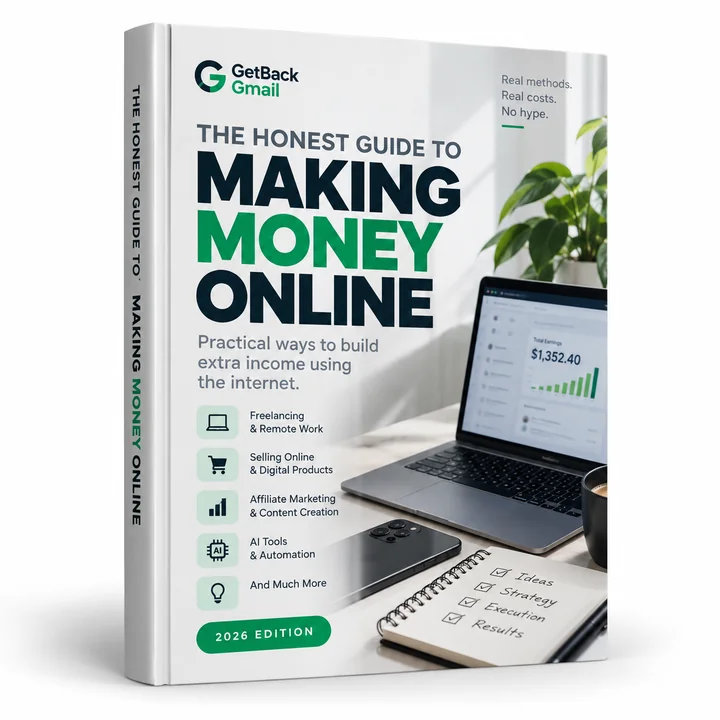
A practical, beginner-friendly ebook about realistic ways to earn money online. Instead of promising quick or guaranteed income, it explains how each method works, what it may cost to start, the skills involved, common mistakes to avoid and practical first steps.
How it relates to freelancing with ai: It covers freelancing and AI tools directly, alongside the other realistic ways to earn online.
Secure checkout by Hotmart · 7-day money-back guarantee
One-time payment · instant digital access
The Honest Guide to Making Money Online
Today's price is shown at checkout in your local currency. Payment and delivery by Hotmart.
Secure checkout by Hotmart · 7-day money-back guarantee
Go through the lessons. If you decide it isn't for you, request a refund within 7 days through Hotmart and you get your money back, no questions asked.
Questions
It's possible, but the first clients usually take time, and early income is often small and irregular. Beginners who get traction tend to offer one focused service and combine marketplaces with direct outreach. See how to start freelancing for the full roadmap.
They work differently. On Upwork you send proposals to job posts using paid Connects; on Fiverr you publish a gig and wait for clients to contact you. Our guide to getting your first client on Fiverr or Upwork compares both.
It varies enormously by skill, experience, hours and market, and there is no reliable average for beginners. Our breakdown of how much freelancers make uses official pay data and shows how fees and taxes change the real number.
Generally yes, if the result is accurate, original to the client's needs and you respect confidentiality. Fiverr, for example, allows AI in all categories but expects freelancers to honor a client's explicit request for non-AI work. Tell clients how you use AI and keep sensitive data out of tools that may train on it.
Usually yes. In the US, self-employed people generally owe self-employment tax on net earnings of $400 or more plus income tax, and may need quarterly estimated payments. The UK, Canada and Australia have their own rules, so check with your tax authority or an accountant.
It's a beginner-friendly ebook that compares realistic ways to earn money online — freelancing, remote work, side hustles, affiliate marketing, digital products, AI tools, selling online and other legitimate paths. For each one it explains how it works, what it may cost to start, the skills involved, common mistakes and practical first steps. It's an overview to help you choose, not a specialist manual on a single method.
Beginners who want an honest map before they spend time or money — people with a job, students, parents at home — and who are willing to put in consistent effort. It is not for anyone looking for a shortcut.
It varies a lot and depends on your skills, effort, market and execution. Many beginners need weeks to months of consistent work before earning anything meaningful, and some never do. Anyone promising fixed results or timelines is not being honest with you.
The price is shown at checkout in your own currency, as a one-time payment. Several of the methods in the ebook can be started with little or no money beyond a phone or computer; paid tools are explained with their real costs before you decide.
Payment and delivery are handled by Hotmart. After checkout you receive an email with access to the ebook, available right away.
Yes. You have a 7-day money-back guarantee under Hotmart's refund policy. If it isn't for you, request a refund within 7 days of purchase and you get your money back.
Yes. It's a digital ebook you can read on a phone, tablet or computer.
The ebook is sold through Hotmart, a large digital-products platform, and comes with a money-back guarantee. It doesn't promise income — it explains methods, costs and risks so you can decide for yourself.
Freelancing means selling a skill to clients who pay per project or per hour. This free step-by-step guide covers choosing a skill, setting up a profile and portfolio, landing first clients, pricing, contracts and taxes, and using AI to cut the repetitive parts of the job. Most beginners need several weeks to a few months of steady outreach before the first paid project, and some take longer.
Secure checkout by Hotmart · 7-day money-back guarantee
How to start freelancing from zero: pick a skill, build samples, choose platforms, land first clients and set up payments, contracts and taxes.
· 8 min read
How to get clients on Fiverr and Upwork with no reviews: gig pages that convert, proposals that get replies, Connects, fees and levels explained for 2026.
· 8 min read
Set freelance rates that cover benefits, unbilled hours, platform fees and taxes. Step-by-step math, a fee gross-up table and when to raise your price.
· 7 min read
Also consider: Make Money With AI · Work From Home Jobs · or browse every way to make money online.
Earnings disclaimer: Results vary from person to person and depend on effort, market and execution. This is educational material and does not guarantee earnings. See our full earnings disclaimer.