Sell Online
How to Validate a Product Before You Spend on Ads
How to validate a product before paying for ads: demand checks, a sample order, break-even math and a cheap organic test, with clear kill criteria.
· 7 min read
From idea to first customer
You've picked what to sell. Now the questions are practical: do you need an LLC, an EIN or a license, how do you take payments, what about sales tax, and where do the first customers come from? This page lays out the setup path in the order that wastes the least money, starting with proof that people will pay. Expect the first sales to take weeks or months.
Secure checkout by Hotmart · 7-day money-back guarantee
To start a business online in the US, validate the idea with a small paid test first, then set up only what that test needs: most solo founders start as a sole proprietorship (automatic when you do business under your own name), add a free EIN from the IRS if they want one, check state and local license and sales tax rules, open a way to take payments and keep business money separate. After that, the real work is a clear first offer and finding the first customers, which usually takes longer than the paperwork.
Part of our honest guide to making money online.
Sound familiar?
You think you need an LLC before you can sell anything
Forums argue about LLCs, EINs and business bank accounts, so you feel you can't start until the paperwork is done, and the idea stays on hold.
Sales tax and licenses feel like a legal minefield
Rules depend on your state, your city and what you sell. You're worried about getting it wrong, but you're also not sure what even applies to a tiny online shop.
You built the website, but nobody came
Weeks on a logo, a store and a domain, and then silence. Most first-time founders spend their energy on setup and almost none on getting in front of buyers.
You don't know how to price or package the first offer
Too cheap and you work for nothing, too expensive and nobody buys. Without a first sale, you have no data to tell which it is.
The turning point
Starting a business online is two jobs: the legal and money setup, and finding people who pay. The setup is mostly simple and cheap; the second job is where most new businesses stall.
Prove demand first
A pre-sale, a few marketplace listings or direct pitches to ten potential buyers tell you whether the idea works before you pay for a store, a logo or a state filing.
Set up in the right order
Sole proprietorship by default, then an EIN, a separate account and the licenses your location requires, and an LLC when liability or growth makes it worth the state fee. You add structure as the business earns it.
Make the money side boring from day one
Separate business money, record every sale and expense, and set aside a share of profit for taxes. That avoids the classic first-year shock of a tax bill nobody planned for.
How this is different: Most 'how to start a business online' advice starts with naming, branding and a website. This path starts with one paying customer and treats everything else as setup that should follow the evidence, not come before it.
How it works
Validate with a small paid test
Turn the idea into one specific offer, show it to real potential buyers through a marketplace, a pre-order or direct outreach, and look for payments or firm requests, not compliments. See how to validate a product.
Choose a legal structure and get your numbers
In the US, doing business under your own name makes you a sole proprietor automatically. An LLC adds liability protection for a state filing fee. An EIN from the IRS is free; a sole proprietor with no employees can use their Social Security number instead.
Check licenses, permits and sales tax
Ask your city or county about a general business license, and check your state revenue department about a seller's permit if you sell taxable goods. Marketplaces such as Etsy collect and remit sales tax for orders in states with marketplace facilitator rules; selling from your own site can leave that job with you.
Set up payments and records
Use the marketplace's built-in payouts or a payment processor for your own site, open a separate account for business money and start a simple spreadsheet or bookkeeping app for every sale and expense.
Launch the first offer and go find buyers
Publish the offer, then spend most of your weekly hours on getting it seen: marketplace search, posts where your buyers already gather and direct, personal outreach. Review the numbers after a few weeks and adjust.
Secure checkout by Hotmart · 7-day money-back guarantee
The skills involved
Writing a clear first offer
Who it's for, what problem it solves, what they get and what it costs, in a few sentences a stranger understands.
Basic US business setup
The difference between a sole proprietorship and an LLC, when an EIN or a DBA (trade name) registration makes sense, and where to check local license rules. The SBA's business guide is the official starting point.
Sales tax basics for online sellers
When marketplaces collect it for you, when a seller's permit is needed, and why the answer depends on your state and what you sell. Our explainer on reseller permits covers the resale side.
Taking payments and getting paid
How marketplace payouts and card processors work, what their fees do to your margin, and how to invoice clients for services. See how to invoice as a freelancer.
Finding the first customers without an audience
Marketplace search, communities, direct outreach and simple content, and how to ask early buyers for reviews and referrals. See marketing digital products with no audience.
Pricing for profit, not just for sales
Covering fees, costs and your time, then raising prices as demand and reviews grow.
Self-employment taxes
In the US, self-employment tax is 15.3% (Social Security plus Medicare) on net earnings, filing is generally required once net earnings reach $400, and quarterly estimated payments apply if you expect to owe $1,000 or more. Rules differ in the UK, Canada and Australia.
Secure checkout by Hotmart · 7-day money-back guarantee
Realistic expectations
| Setup item | Do you need it on day one? | Typical cost | Where to check |
|---|---|---|---|
| Sole proprietorship | Automatic if you sell under your own name | None | SBA: choose a business structure |
| LLC | Optional; worth considering once liability or revenue grows | State filing fee plus any annual report fee; varies by state | Your secretary of state; SBA guidance |
| EIN | Optional for a sole proprietor with no employees; needed once you hire employees or run a partnership or corporation, and many banks ask for one | Free from the IRS (never pay a website for it) | IRS.gov/EIN |
| DBA (trade name) | Required in most states if you trade under a name other than your own | Small filing fee; varies by state or county | State, county or city office |
| Business license or permit | Depends on your city, county and activity | Varies by location | Your city or county; SBA licenses and permits page |
| Seller's permit and sales tax | Depends on your state and what you sell; marketplaces often collect for you | Varies by state | Your state's department of revenue |
| Separate account and bookkeeping | Strongly recommended from the first sale | Free to low | Your bank; a spreadsheet works at the start |
Requirements and fees vary by state and city and change over time; this is a general orientation, not legal or tax advice. Outside the US: UK sole traders must register for Self Assessment if they earn more than £1,000 in a tax year, Canadians report business income on CRA Form T2125, and Australians can apply for an ABN for free through the Australian Business Register.
Is it right for you?
This is for you if…
This is NOT for you if…
401
free guides published
3,028
official sources cited
0
income promises
Oct 3, 2026
last updated
Every guide is checked against official sources. See our editorial policy.
From readers of the ebook
“I found some interesting ideas for earning extra income in my spare time.”
“The examples helped me think about how I could use my skills for freelance work.”
“I liked exploring extra-income options that could fit around my studies.”
“The information gave me a starting point for planning a small side project.”
“I felt more organized after outlining what I could offer and how much time I had available.”
Shared by buyers who agreed to publication. These are individual experiences, not typical results, and none of them describes earnings. See our earnings disclaimer.
Who's behind this
Getback publishes free, practical guides on making money online and managing it well. We show real costs, realistic timelines and the trade-offs most “gurus” skip — and we never promise income. Read how we research and update every guide in our editorial policy.
Go deeper
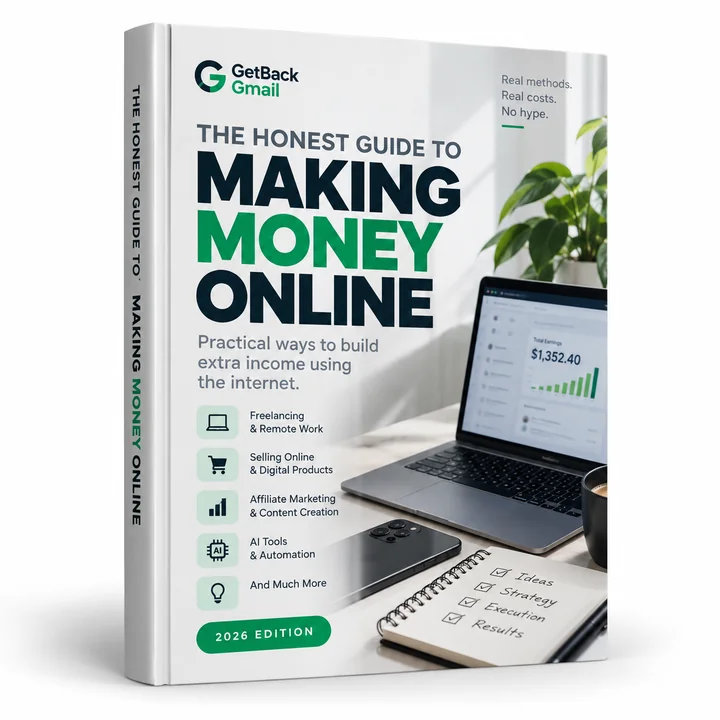
The ebook
A practical, beginner-friendly ebook about realistic ways to earn money online. Instead of promising quick or guaranteed income, it explains how each method works, what it may cost to start, the skills involved, common mistakes to avoid and practical first steps.
How the ebook fits: The ebook helps with the business side of this page: how each online model works, what it may cost, the skills involved and the mistakes beginners make before their first sale. It does not cover legal registration, state licenses or sales tax in detail, and it is not legal or tax advice; for those steps, this page points you to the official SBA and IRS pages.
Secure checkout by Hotmart · 7-day money-back guarantee
One-time payment · instant digital access
The Honest Guide to Making Money Online
Today's price is shown at checkout in your local currency. Payment and delivery by Hotmart.
Secure checkout by Hotmart · 7-day money-back guarantee
Go through the lessons. If you decide it isn't for you, request a refund within 7 days through Hotmart and you get your money back, no questions asked.
Free PDF
Every step to get started, a 7-day plan, the numbers to track and the scams to skip — on two printable pages.
Questions
No. In the US you're automatically a sole proprietor when you do business under your own name, and many online sellers start that way. An LLC can protect personal assets from business debts and lawsuits, so it becomes more relevant as revenue, risk or contracts grow.
It depends on your city, county, state and what you sell; there is no single national rule. Check with your local government and state revenue department. Our article on whether you need a business license to sell on Etsy walks through the questions to ask.
It can start near zero: a sole proprietorship and an EIN cost nothing, and services or marketplace listings need little money. Costs rise with an LLC filing, your own website, paid tools, inventory or ads, so add them after the idea has shown demand.
Sometimes. Marketplaces such as Etsy collect and remit sales tax for orders in states with marketplace facilitator rules, but sales from your own website may require you to register and collect, depending on your state and the product. Many services are not taxed, but some states tax certain digital goods and services.
Go where buyers already are: marketplace search, communities, your existing network and direct, personal outreach. Expect many pitches or listings for each early sale, and use every response to sharpen the offer.
It's a beginner-friendly ebook that compares realistic ways to earn money online — freelancing, remote work, side hustles, affiliate marketing, digital products, AI tools, selling online and other legitimate paths. For each one it explains how it works, what it may cost to start, the skills involved, common mistakes and practical first steps. It's an overview to help you choose, not a specialist manual on a single method.
Beginners who want an honest map before they spend time or money — people with a job, students, parents at home — and who are willing to put in consistent effort. It is not for anyone looking for a shortcut.
It varies a lot and depends on your skills, effort, market and execution. Many beginners need weeks to months of consistent work before earning anything meaningful, and some never do. Anyone promising fixed results or timelines is not being honest with you.
The price is shown at checkout in your own currency, as a one-time payment. Several of the methods in the ebook can be started with little or no money beyond a phone or computer; paid tools are explained with their real costs before you decide.
Payment and delivery are handled by Hotmart. After checkout you receive an email with access to the ebook, available right away.
Yes. You have a 7-day money-back guarantee under Hotmart's refund policy. If it isn't for you, request a refund within 7 days of purchase and you get your money back.
Yes. It's a digital ebook you can read on a phone, tablet or computer.
The ebook is sold through Hotmart, a large digital-products platform, and comes with a money-back guarantee. It doesn't promise income — it explains methods, costs and risks so you can decide for yourself.
You've picked what to sell. Now the questions are practical: do you need an LLC, an EIN or a license, how do you take payments, what about sales tax, and where do the first customers come from? This page lays out the setup path in the order that wastes the least money, starting with proof that people will pay. Expect the first sales to take weeks or months.
Secure checkout by Hotmart · 7-day money-back guarantee
How to validate a product before paying for ads: demand checks, a sample order, break-even math and a cheap organic test, with clear kill criteria.
· 7 min read
Do you need a business license to sell on Etsy? Etsy doesn't ask for one, but your city, county or state might. Licenses, sales tax permits, DBAs, taxes.
· 8 min read
A reseller permit is a state sales tax registration that lets you buy inventory tax-free. Who needs one, how to apply, the cost and the misuse penalties.
· 7 min read
Also consider: Sell Digital Products · Freelancing With AI · or browse every way to make money online.
Earnings disclaimer: Results vary from person to person and depend on effort, market and execution. This is educational material and does not guarantee earnings. See our full earnings disclaimer.